13 skills · plain markdown · nothing to install

Your agent builds fast. These make it build right.

The methods we use on real client sites, written as markdown your coding agent reads when it reaches each stage, so it builds in the right order instead of a confident wrong one.

✓ Claude Code✓ Cursor✓ Any agent✓ Instant download
What you actually get

A folder your agent already knows how to read.

No plugin, no account, no API. Drop it in your project and your agent picks up each skill when it reaches that work. You can read every word before you trust it.

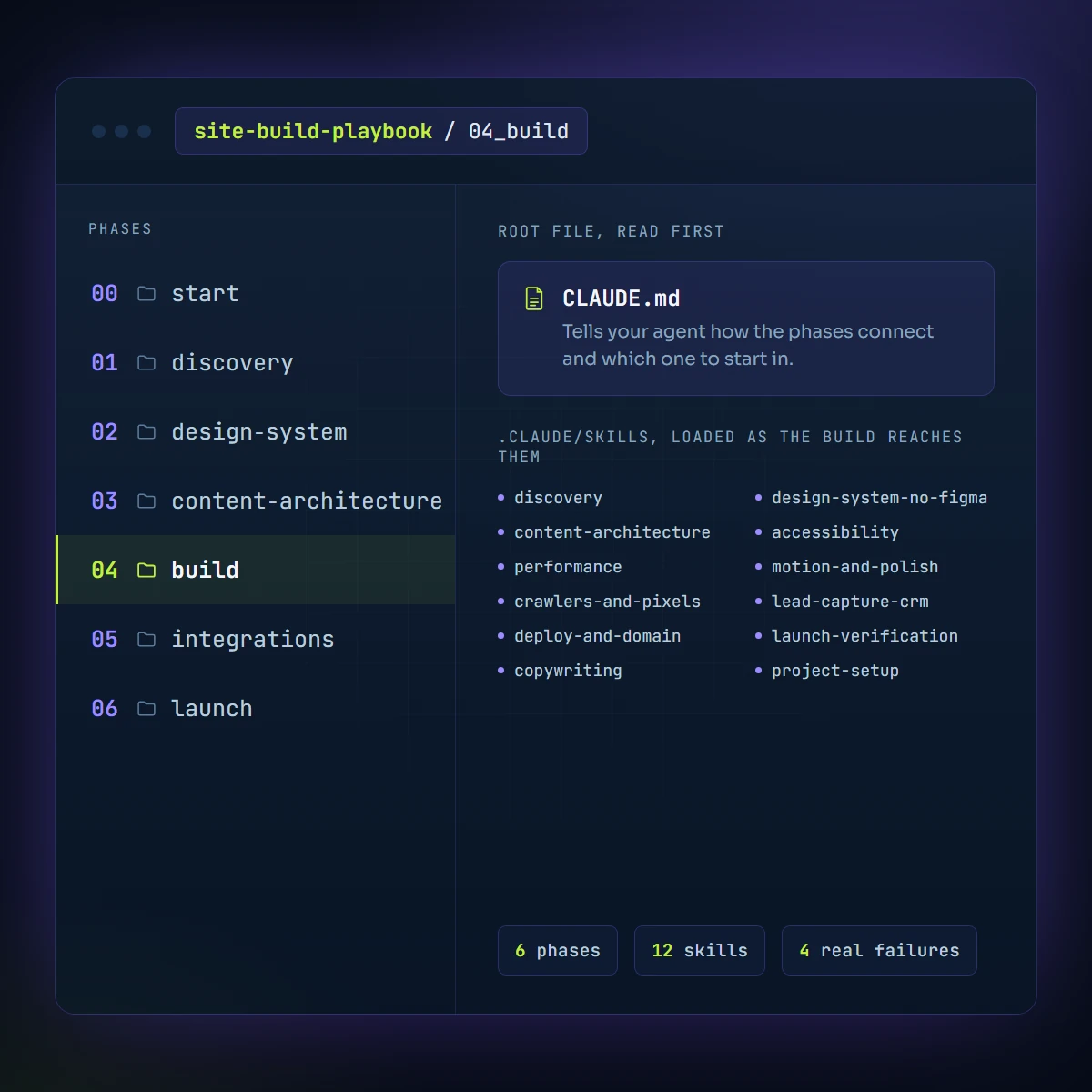
The site-build-playbook folder open in an editor: six numbered phase folders, CLAUDE.md as the file to read first, and the skills loaded as the build reaches them.
13Skills in the catalog
6Build phases, in order
$231Bought separately
$97The whole set
The catalog

Every skill, in the order you need it.

Each one is a folder your agent reads at that stage of the build. Buy the one you need, or take the set.

Before anything

Where the project lives, and what only the owner can tell you.

Project Setup

The most common project failure is no folder at all.

Create the project folder and its context structure before any build work starts. Ten minutes that decide whether the project is still navigable in three months.

What it prevents

Work happening in a scratch directory, decisions living in a chat history, and assets in a downloads folder. When the session ends, the project effectively ends with it.

$12
On its own
  • The folder structure, with a reason for each part
  • Why context files beat one long document
  • Writing CLAUDE.md on day one, not at the end
  • Open items as a real tracked artifact
In the complete set →

Discovery

The questions only the owner can answer, asked before they block you.

Gather what only the business owner can tell you, before any design or code, and produce the open-items list that tracks a project to launch.

What it prevents

A build that stalls three weeks in because nobody asked who controls the Google Business Profile, or what the licensing wording is allowed to say.

$19
On its own
  • What to ask in the first conversation
  • Photography, specifically, and why it stalls builds
  • Tracking open items where the client can see them
  • The honest framing that gets answers faster
In the complete set →

Design

A design system derived from the brand, without opening Figma.

Design System Without Figma

A logo pack and a color or two is the normal starting point. Most guidance pretends otherwise.

Derive a complete, buildable design system from whatever brand assets exist, with no comps and no designer.

What it prevents

A templated design where the accent color could be swapped for any other and nothing would feel wrong, which means no decision was ever made.

$24
On its own
  • What to extract from a brand pack first
  • The eight decisions that constitute a design system
  • Writing them down as tokens immediately
  • Composition when you have no comp to follow
  • Where clients actually push back
In the complete set →

Content

URL structure and words that do not invent facts the business has to defend.

Content Architecture

Service-area pages are where local sites quietly get filtered out of search.

Design the URL structure, service silo, and service-area pages for a local business without tripping Google near-duplicate filtering.

What it prevents

Twenty city pages that differ only by a swapped place name, which rank for nothing and can drag the rest of the site with them.

$19
On its own
  • The silo, and the rule that makes or breaks it
  • How many area pages is too many
  • FAQs per category, not per service
  • Slugs are permanent, so decide once
  • Replacing an existing site without losing rankings
In the complete set →

Copywriting

Invent aesthetic copy freely. Never invent a fact the business has to stand behind.

Write marketing copy for a local business without inventing claims the owner then has to defend to a customer, or a regulator.

What it prevents

A plausible guess about turnaround time, licensing or a guarantee shipping unnoticed, because a plausible guess is exactly what gets shipped unnoticed.

$14
On its own
  • Where the line sits, concretely
  • Reviews and testimonials, and what is never acceptable
  • Page structure that works
  • Voice defaults and formatting conventions
In the complete set →

Build

The parts that decide whether the site feels premium or templated, and whether it is fast.

Motion and Polish

The thing that makes sites look templated is not the color. It is the absence of a decision.

Make a site feel premium rather than generic, using motion deliberately, and decide whether to add an animation library at all.

What it prevents

Scroll effects that feel expensive on a laptop and break the page on a phone, and a hero that imports an animation library before the first paint.

$24
On its own
  • Choosing a motion library, or not adding one
  • The rule that outranks every other motion decision
  • Killing motion on mobile, in CSS and in JS
  • Going wide on desktop without becoming unreadable
  • Video needs a poster, always
In the complete set →

Performance

Most of the Lighthouse report is unscored. Optimizing it is time you do not get back.

Diagnose and fix Core Web Vitals on a marketing site, especially mobile LCP, by reading the breakdown before touching anything.

What it prevents

Days spent on "reduce unused JavaScript" while the actual problem is a hero video that is 76% of page weight.

$24
On its own
  • What actually scores, and what does not
  • Reading the LCP breakdown before acting
  • Keeping animation libraries off the critical path
  • Preloading the LCP image, and responsive images
  • Background video, usually your largest asset
In the complete set →

Accessibility

The failures that actually appear on marketing sites, not the whole WCAG surface.

Reach and hold a perfect accessibility score, and understand what the automated score still cannot tell you.

What it prevents

A hidden menu whose links are still focusable, icon buttons that only look labelled, and muted text that fails contrast at the size you shipped it.

$14
On its own
  • Hidden things that are still focusable
  • aria-label on the wrong element
  • Contrast on muted text, with the arithmetic
  • Touch targets, and running both viewports
In the complete set →

Integrations

Leads that cannot vanish, and tracking that records what actually happened.

Lead Capture and CRM

A CRM push that fails silently is worse than one that fails loudly.

Build lead capture that cannot silently lose a lead, and integrate a CRM over its API without coupling your site to it.

What it prevents

Leads arriving by email while the CRM quietly receives nothing for weeks, because the failure was correctly swallowed and nothing visibly broke.

$24
On its own
  • Email as the safety net that always wins
  • Keeping the CRM swappable behind one call
  • OAuth refresh tokens: the failure that looks like success
  • Pinning the API version, and expecting drift
  • Verifying against production, end to end
In the complete set →

Crawlers and Pixels

Creating a second analytics property next to a live one loses the history and reports on nothing.

Set up robots.txt, llms.txt, sitemaps and whatever marketing pixels the business already runs, reusing the accounts they own.

What it prevents

Conversion tracking that was never wired, so ad spend optimizes against a signal nobody is sending.

$19
On its own
  • Asking what already exists before creating anything
  • Conversion tracking, the part that actually matters
  • robots.txt and llms.txt, with a worked example
  • Sitemaps that match the architecture
In the complete set →

Launch

Going live, and proving it works rather than assuming.

Deploy and Domain

Every account in the owner name. Anything else holds a business hostage by accident.

Get the site onto a host, point a real domain at it, and hand over accounts the owner actually controls.

What it prevents

A cutover that takes the business email down with it, and a client who cannot access their own registrar a year later.

$19
On its own
  • Ownership, settled before anything is created
  • Deploying early, to a preview URL
  • Environment variables that do not leak
  • Domain cutover without touching MX
  • The handover itself
In the complete set →

Launch Verification

A build that compiles proves nothing about what a visitor receives.

Take a finished site live and prove it works, against the deployed site rather than the source.

What it prevents

A site that shipped with every lead form redirecting to a 404, unnoticed for weeks while ad spend kept running.

$19
On its own
  • The pre-cutover checklist
  • DNS mechanics, and why resolvers disagree
  • Proving the new host works before DNS moves
  • What to verify in the first hour after launch
In the complete set →

Running a practice

Once one project works, the problem becomes all of them at once.

Multi-Client Workspace

Three folders named for the same client, and the deployed code is in none of them.

Put every client project under one parent folder with a routing layer on top, so one chat can find any client and load only the context it needs.

What it prevents

An agent asked to fix the bug on a client site guessing which of four folders is live, editing a dead copy, and reporting success.

$19
Sold on its own
  • The roster that tells an agent what is live
  • One shape for every client, so one is all of them
  • Migrating in twenty minutes, not over a weekend
  • How to tell which folder is really deployed
Ask about this skill →
The complete set

The Site Build Playbook, in order.

All twelve build skills, the six phase folders that sequence them, and a reviewer that checks a phase against its own done list before you move on.

12 skills, separately$231
Six sequenced phasesincluded
Phase reviewerincluded
Together$97
Get all 12 for $97 →

Instant download · nothing to install · updates included

Questions

Worth answering.

Does this work with something other than Claude?

Yes. It is markdown. Anything that reads files in your project can follow it. It is written and tested against Claude Code, so that is the fit it was built for, but nothing in it is Claude specific.

Is this a template or a codebase?

Neither. There is nothing to npm install. It is the sequence, the decisions, and the specific mistakes that cost real money on real builds.

I only need one. Do I have to buy the set?

No. Each skill is priced and stands on its own. The set exists because most of these problems arrive together, and because the order they go in is worth more than the pieces.

Will it go out of date?

The parts tied to a specific tool will, eventually. The order you do things in, the questions only an owner can answer, and the failures are not tied to a framework version. Updates are free.

What if it is not useful to me?

Email me and I will refund you. I would rather return the money than have it sitting in a folder you resent.

Start with the one
you need today.

You do not need the whole shelf. Take the skill that solves this week's problem, and see whether the method earns the next one.